

BASIC SHIRTS MN LIMITED

Software engineering, cloud solutions and ongoing technical support

Abstract visualisation of digital infrastructure as a glowing network mesh

Information technology company

Software systems
built to be
maintained

BASIC SHIRTS MN LIMITED designs, builds, integrates and supports software and cloud infrastructure — with the documentation, testing and observability that keep those systems workable long after release.

Custom software and web applications

Cloud architecture and deployment automation

Integration, consulting and ongoing support

Introduction

An engineering partner for systems that matter

We work with organisations whose operations depend on software: internal platforms that coordinate daily work, customer-facing applications, and the integrations that hold them together. The starting point is rarely a blank page — it is usually a system that needs to do more, cost less, or become safe to change.

Our method is deliberately unglamorous. Understand the process, model the data honestly, implement in reviewable increments, automate the checks, and make production behaviour visible. Decisions are written down with their trade-offs so the reasoning survives staff changes and years of iteration.

The result is software your team can operate confidently: documented, tested, observable, and free of dependencies on any single person's memory.

Capabilities

Core technical capabilities

The engineering foundations applied across every engagement, whatever the service area.

01

Application architecture

Service boundaries, data models and interface contracts designed for change rather than for a single release.

02

Backend engineering

APIs, background processing, scheduled jobs and transactional logic built with explicit error handling.

03

Frontend engineering

Accessible, responsive interfaces with a documented component structure and measured performance.

04

Data engineering

Schema design, migrations, reporting queries and pipelines that keep records consistent across systems.

05

Platform automation

Infrastructure as code, containerisation and deployment pipelines that make environments reproducible.

06

Observability

Structured logging, metrics, tracing and alerting designed with the feature rather than bolted on later.

Discipline 01

Custom software development

When a process is specific to how your organisation works, a bespoke system can encode the real rules — including the exceptions that generic products force you to work around.

  • Requirements gathered from the people who perform the work, then validated against the data the process actually produces.
  • Domain modelling first: entities, states and transitions defined before interface design begins.
  • Implementation in reviewed increments, each with automated tests and a deployable result.
  • Role-based access, audit trails and data retention behaviour built in where the process requires them.
Application source code on a monitor during a development session
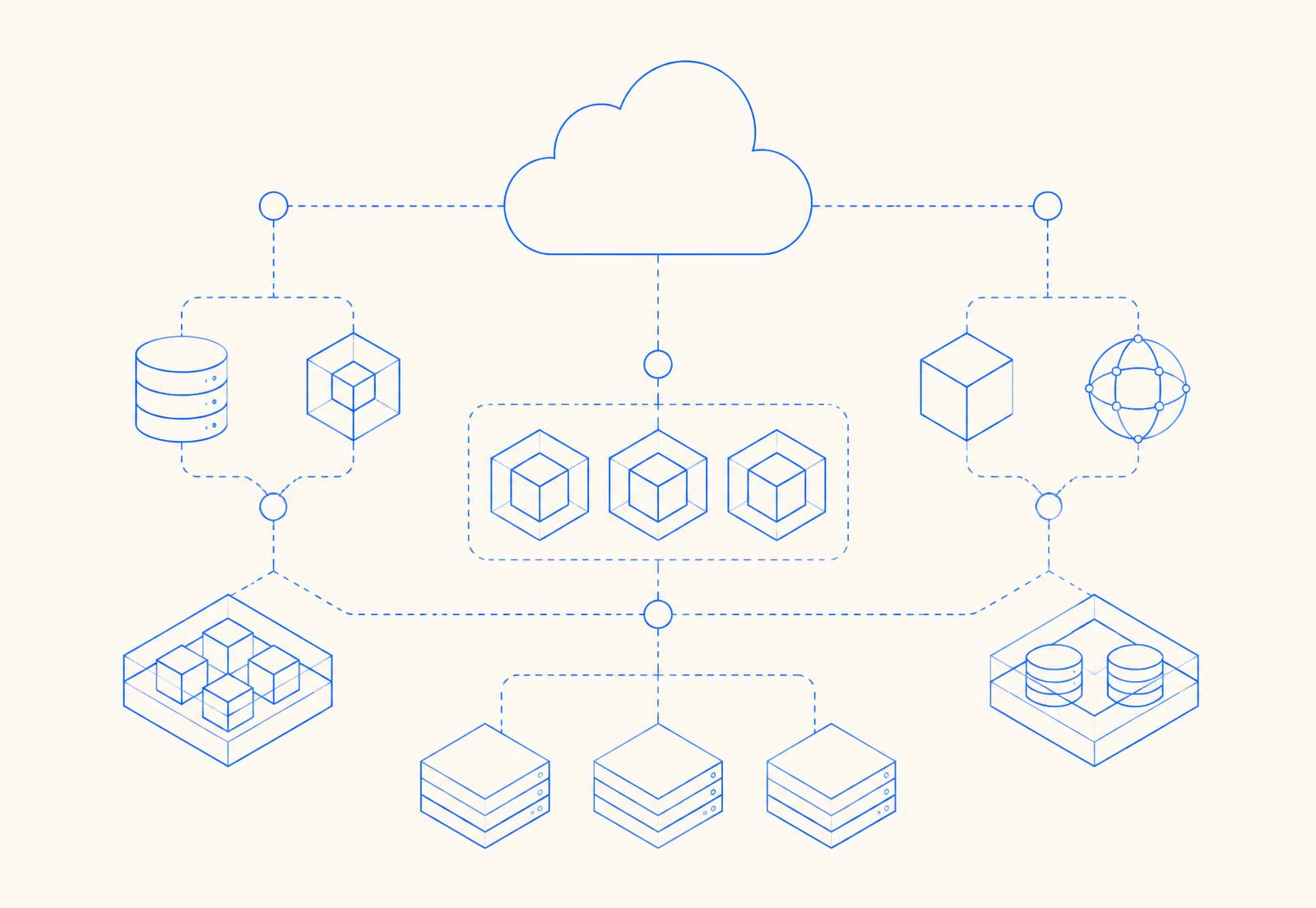
Line diagram of a cloud architecture linking services, containers and databases

Discipline 02

Cloud and infrastructure

Cloud work is judged on three things: whether environments can be recreated from source, whether production behaviour is visible, and whether cost tracks real demand.

Provisioning

Networking, compute, storage and identity defined as code, applied through review.

Delivery

Container images, automated pipelines and a documented rollback route for every release.

Resilience

Backups with tested restores, health checks and recovery procedures written down in advance.

Cost review

Resource sizing and usage examined against observed load rather than initial assumptions.

Discipline 03

Systems integration

Most operational friction is not caused by a missing application. It is caused by systems that hold overlapping information and never agree.

We map every interface that already exists — APIs, exports, scheduled transfers, files moved by hand — and decide which of them should remain. A canonical identifier strategy and field-level mapping are agreed before code is written.

Integrations are then built for the realities of distributed systems: idempotent operations, retries with backoff, error queues that can be inspected, and reconciliation that proves both sides still match.

Integration health is monitored like any other production concern, with alerts for failure rates and growing backlogs rather than silent divergence.

Discipline 04

IT consulting and technical planning

Independent assessment before commitments are made — particularly for decisions that are expensive to reverse.

A

Architecture review

An assessment of the current design against the objectives it is now expected to serve.

B

Technology selection

Options compared against explicit criteria, including what your team can maintain.

C

Migration planning

Sequencing, cut-over steps, data movement and rollback defined before work starts.

D

Delivery roadmap

Phased plan with dependencies, risks and estimation ranges suitable for budgeting.

Process

How delivery runs

The same sequence applies to a new build, a migration or a maintenance handover; only the depth of each step changes.

  1. 01

    Discovery

    Objectives, constraints, systems in scope, and the measurement that will define success.

  2. 02

    Technical planning

    Architecture direction, scope boundary, sequencing and estimation ranges, written down.

  3. 03

    Implementation

    Reviewed increments with automated checks running on every change.

  4. 04

    Verification

    Testing against agreed criteria, including integration points, error paths and performance.

  5. 05

    Release

    Automated deployment, post-release checks and a documented rollback route.

  6. 06

    Operate and improve

    Monitoring in production, findings resolved, next increment planned from evidence.

Assurance

Quality and security practices

Practices applied continuously through delivery rather than inspected at the end.

Q1

Review on every change

Each change is read by another engineer, with attention to error handling, readability and test coverage.

Q2

Layered testing

Unit tests for logic, integration tests across boundaries, end-to-end checks for critical paths.

Q3

Continuous integration

Linting, type checks, builds and test suites run automatically before anything is merged.

Q4

Least privilege

Access scoped narrowly for people and services alike, with secrets held in managed stores.

Q5

Dependency hygiene

Third-party packages tracked, reviewed and updated as part of routine maintenance.

Q6

Data protection in transit and at rest

Encrypted transport, validated inputs and considered retention behaviour as baseline requirements.

Illustrative examples

Example scenarios

The scenarios below are illustrative examples written to show how we approach typical technical situations. They are not descriptions of specific clients or completed projects.

Example scenario

A spreadsheet-driven process replaced by an internal application

An operations team coordinates work through shared spreadsheets, with rules held informally. The engagement models the workflow as explicit states and transitions, migrates historical records, and delivers an application with role-based access and an audit trail. Reporting that previously required manual consolidation becomes a query against a single source.

Example scenario

A monolithic application moved to reproducible cloud environments

A long-running application is deployed manually, and environments have drifted apart. The work defines infrastructure as code, containerises the application, introduces an automated pipeline with rollback, and adds monitoring and alerting. Environments can then be recreated from source rather than reconstructed from memory.

Example scenario

Two systems reconciled through an integration layer

A finance system and a customer platform hold overlapping records that gradually diverge. The engagement establishes canonical identifiers, field-level mapping and queue-based synchronisation with idempotent operations, an inspectable error queue, and a scheduled reconciliation report that surfaces mismatches early.

Example scenario

An inherited codebase brought under control before extension

A system arrives without documentation, tests or a reliable build. The first phase reconstructs the build, adds test coverage around the highest-risk logic, documents the architecture and deployment steps, and produces a prioritised list of findings — so that later feature work proceeds on a known foundation.

Collaboration

Communication that keeps work predictable

We aim to be an easy technical counterpart: clear about progress, direct about risk, and straightforward to plan around.

Each engagement has one agreed written channel, a shared backlog, and a regular update stating what changed, what is next and what is blocked. Anything that affects scope, cost or architecture is raised when it appears rather than at the end of a phase.

Where an internal team is involved, we follow their repository conventions and review process, and we document what we build so understanding is shared rather than concentrated on our side.

Collaborative studio workspace with monitors, notes and architecture sketches

Support

Ongoing support and maintenance

Most of a system's life happens after launch. Maintenance is treated as engineering work, not an afterthought.

Corrective work

Defects investigated to root cause, with the regression check added alongside the fix.

Preventive updates

Runtime, dependency and security patches applied on a predictable schedule.

Monitoring follow-up

Alerts triaged, noisy signals tuned, and recurring conditions addressed at source.

Performance and cost

Usage reviewed as it changes, with sizing and query work based on measurements.

Incremental improvement

Small enhancements delivered in agreed increments rather than accumulated into a rewrite.

Living documentation

Runbooks, configuration notes and architecture records kept current as the system evolves.

FAQ

Frequently asked questions

Every answer is shown in full below.

What kind of work does the company take on?
Custom software development, web application development, cloud and infrastructure work, systems integration, IT consulting and long-term maintenance of production systems.
Can you join a project that is already underway?
Yes. We begin by reviewing the codebase, dependencies, tests and deployment process, then agree a first change set that is small enough to verify quickly.
How do engagements usually start?
With a written brief and a short discovery step. The output is an agreed scope boundary, an architecture direction and a sequence of increments, all recorded in writing.
Who owns the code and infrastructure definitions?
You do. Application code, infrastructure as code and documentation are delivered into repositories and cloud accounts under your control.
How are technologies chosen?
By requirement and maintainability. We prefer widely supported, well-documented technologies, and we record the reasoning and alternatives for every significant decision.
What does ongoing support cover?
Defect resolution, dependency and security updates, monitoring and alert handling, incident investigation, performance and cost review, and small planned improvements.
How is progress reported?
Through a regular written update covering what changed, what is next and what is blocked, alongside access to the repository, issue tracker and deployed environments.
How do we get in touch?
Written enquiries are handled by email at kathylong197743@gmail.com. The company website is basicshirtsmn.com.

Company and contact information

BASIC SHIRTS MN LIMITED

Software development, cloud solutions, IT consulting, systems integration and ongoing technical support. Enquiries are handled in writing by email.

Contact

kathylong197743@gmail.com

basicshirtsmn.com

Details are shown as plain text. Please include the outcome you need, the systems already in use, and any constraints that apply.